

Incoming MBA student, independent consultant, and educator working at the intersection of organizational behavior, project management, and digital modernization.
Selected Projects

Designed, built, and deployed the full production site for Drawn From Publishing — a five-section publishing platform (Catalog, Series, Library, Community, About) with a complete account and library system behind login. The site sells digital and print folios direct, processes real transactions through Stripe and Amazon, surfaces audio releases distributed across every major DSP, and houses the operating brand identity end-to-end. Built solo as a working storefront, not a portfolio piece — every page in production, every checkout live.

BrandForge is an internal tool used in consulting with clients to quickly iterate through the ideation phase for Logos, Business Cards, Media & Imagery, as well as Mockups. Future plans include releasing this structured system for public use with monetization.
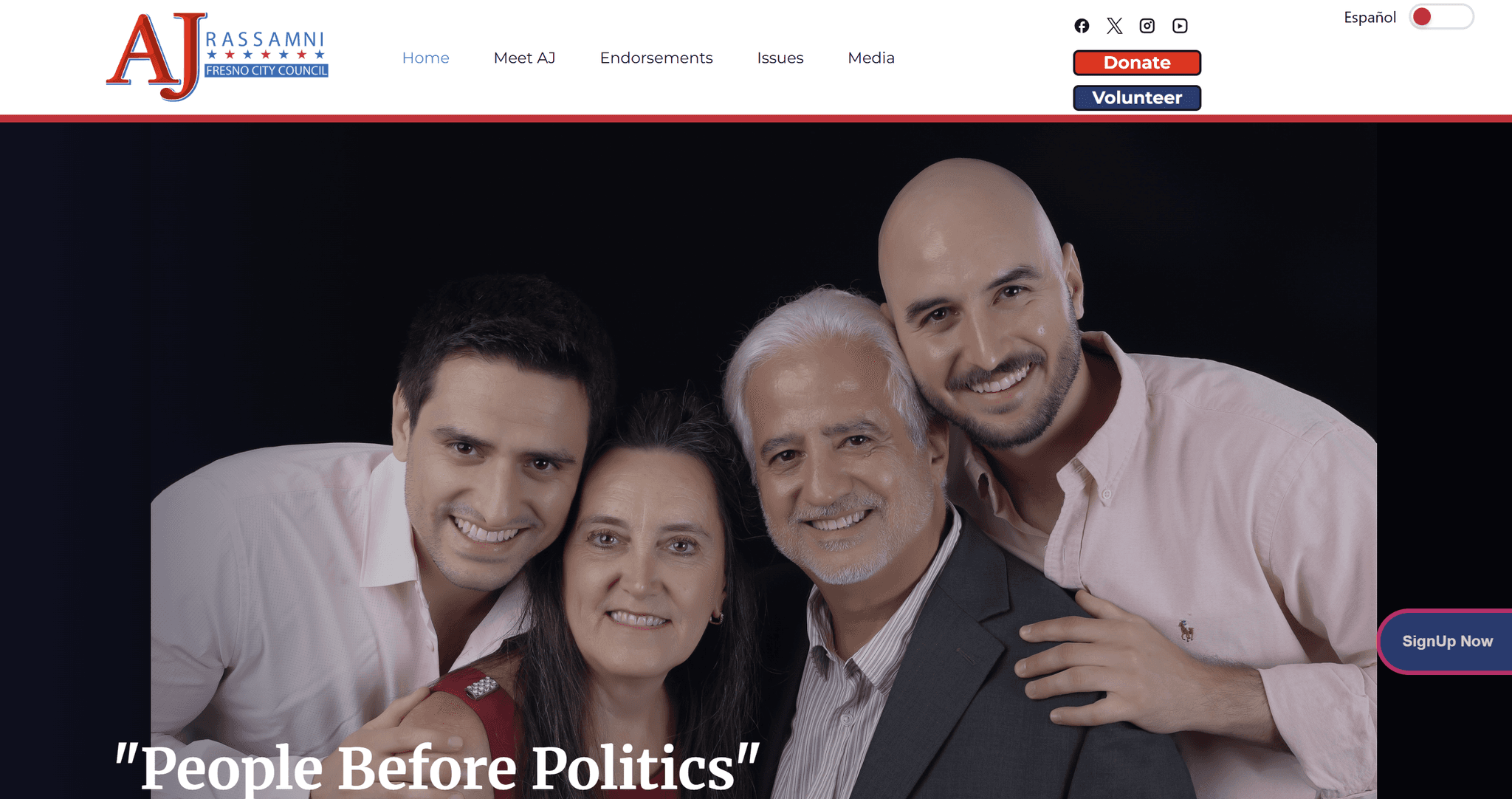
Official campaign website for AJ's city council candidacy. Features responsive design, donation integration, volunteer sign-up, and event management. The website serves as a hub for campaign information and community engagement.
Recent Achievements
Founded and operate Drawn From Publishing, an imprint under Imaginarii that adapts foundational texts into sequential art and original instrumental scores. Active catalog across Kindle, Spotify, iTunes, print, and major DSPs.
Recognized by CSU Fresno for academic achievement among returning students.
Article reference to come.
Graduating with the highest of three Latin honors distinctions awarded by California State University, Fresno, reserved for students completing their degree with a cumulative GPA of 3.85 or higher.
Completed the Computer Information Systems track at the Craig School of Business, California State University, Fresno. Coursework concentrated in Information Systems, Machine Learning, Deep Learning & Artificial Intelligence.
Selected Writing
THE STATE OF THE HOUSE
Drawn From Publishing is a live, operating publishing house. The website is up at drawnfrom.com with five sections — Catalog, Series, Library, Community, About — and a full account/library system behind login. Two issues of Drawn from Scripture (Genesis Ch. 1 and Ch. 2) are on Kindle and direct on-site at $0.99 digital, $8.99 print via Mixam. Three audio releases are live across Spotify, Apple Music, and every major DSP through DistroKid under the McGauley Labs label. The YouTube channel sits at 92 subscribers and is growing on a $25 promotion campaign with a $0.26 cost-per-subscriber. The first $5.97 of Kindle giveaway promotion just ran. The newsletter is collecting names. Stripe and Amazon are taking real money.
This is not a pre-launch business model. It is a working one — and the model has shifted in three meaningful ways since the prior team presentations:
-
The format pivot. The audio side is now arc-based LPs, not chapter-locked EPs. Vol. I covers Genesis 1–3 with A1–A7 and B1–B8 sequenced to cover every verse. Vol. II covers an arc-defined slice of Ch. 4–9. Dante's Inferno Canto I gets its own standalone 16-track LP. This unlocks vinyl and CD as a real distribution channel via Elastic Stage POD.
-
The content recycling flywheel. One unit of work — a comic chapter — now produces five distinct sellable assets: the digital folio, the print folio, the Kindle edition, the narrated long-form video, and the audio-only re-export pushed back through DistroKid. Music written for the chapter scores all of them and itself becomes a sixth asset on its own LP.
-
The audio-Bible thesis. Once enough chapters are narrated and enough music is composed, the catalog becomes a complete instrumental-and-narration walk through scripture from Genesis to Revelation. Sold as albums on the way, sold as a complete experience at the end. There is no direct competitor to this. It is the single largest defensible product in the roadmap.
Pay for quality once. Extract returns across every channel that quality opens.
The rest of this document walks the full Business Model Canvas — all nine modules — as the operating model stands today. It is intended as a working reference for decisions, not as a deliverable for a class. Where prior Team Presentations are still accurate, this document supersedes them. Where the business has moved, this document records where it has moved to.
I served as a Web Developer intern within the Marketing Department at Fresno State Student Housing, supervised by Anthony in Marketing with additional oversight from Housing directors such as Michele Dunlap. The marketing team consists of five members: a digital designer, a social media marketer, an assistant manager, and our supervisor. My role focused primarily on website maintenance, development, and optimization but expanded to include maintaining and creating digital signage solutions, conducting SEO analysis, and developing automated solutions for various business processes. The position offered significant autonomy in identifying and implementing technical solutions while collaborating across departments to address multiple organizational needs. As one of Central Valley's largest student housing providers, Fresno State Housing maintains a significant web presence that directly impacts student experience and operational efficiency.
Crime in Fresno and the broader Central Valley has tracked the national upward trend over the last several years, accelerated by the disruptions of the COVID-19 pandemic and a sustained opioid crisis. Among the underexplored contributors to that increase is aggressive driving — a category of road behavior that imposes risk well beyond the vehicle itself and may correlate with violent expressions in other domains of life. This paper evaluates whether augmented enforcement of traffic laws in Fresno could function as a proactive intervention against both roadway aggression and the spillover effects that flow from it. The investigation proceeds along three empirical lines and one theoretical line. First, publicly available Fresno Police Department traffic-stop data from 2014 through 2017 is reconstructed, adjusted for known reporting gaps, and visualized to test the popular narrative of declining enforcement. Second, FBI Uniform Crime Report data for the ten most populous California cities is normalized against population to characterize Fresno's violent-crime profile relative to its peers. Third, a preliminary survey of nine Fresno residents in City Council District 4 captures resident perceptions of aggressive driving frequency, enforcement visibility, and the perceived link between road aggression and broader violence; responses are tested against the null using one-sample t-tests at α = 0.05. Eight criminological frameworks — spillover theory, the brutalization hypothesis, reversal theory, the frustration-aggression hypothesis, both Mertonian and Agnew strain theories, social learning theory, and moral disengagement — are then applied to interpret the findings. Three structural conclusions emerge. First, the available enforcement data is insufficient to support strong claims of either decline or improvement; the dataset is fragmented, capped at three usable years, and was subsequently consolidated to the state under AB 953 with no evident continuity for independent analysis. Second, while Fresno's overall violent-crime rate falls within the average band of comparable California cities, aggravated assault accounts for over 60% of its violent offense profile — a categorical concentration worth further study in the context of road-related aggression. Third, when survey responses marked “unsure” are excluded, respondents register a statistically significant belief both that reduced police presence has driven aggressive driving upward and that aggressive driving correlates with violent behavior off the roadway. The paper concludes with targeted recommendations for cross-district comparative analysis, durable historical data preservation, grass-roots community engagement, and sustained study of enforcement efficacy.